
We provide analysis that goes beyond the headlines—examining media coverage, identifying potential biases, and unpacking the political and structural forces shaping major events. While not a news outlet, our focus is on delivering deeper context to support a clearer understanding of not only what is happening, but why it matters and its broader implications. Subscribe below to stay informed and receive updates directly to your mailbox.
July 2026
A series of significant political, legislative and security developments across the United Kingdom, from a change of Prime Minister and major reforms to national security and immigration law, to evolving protest activity, hate crime trends and developments in Prevent.
A Change of Prime Minister Without an Election
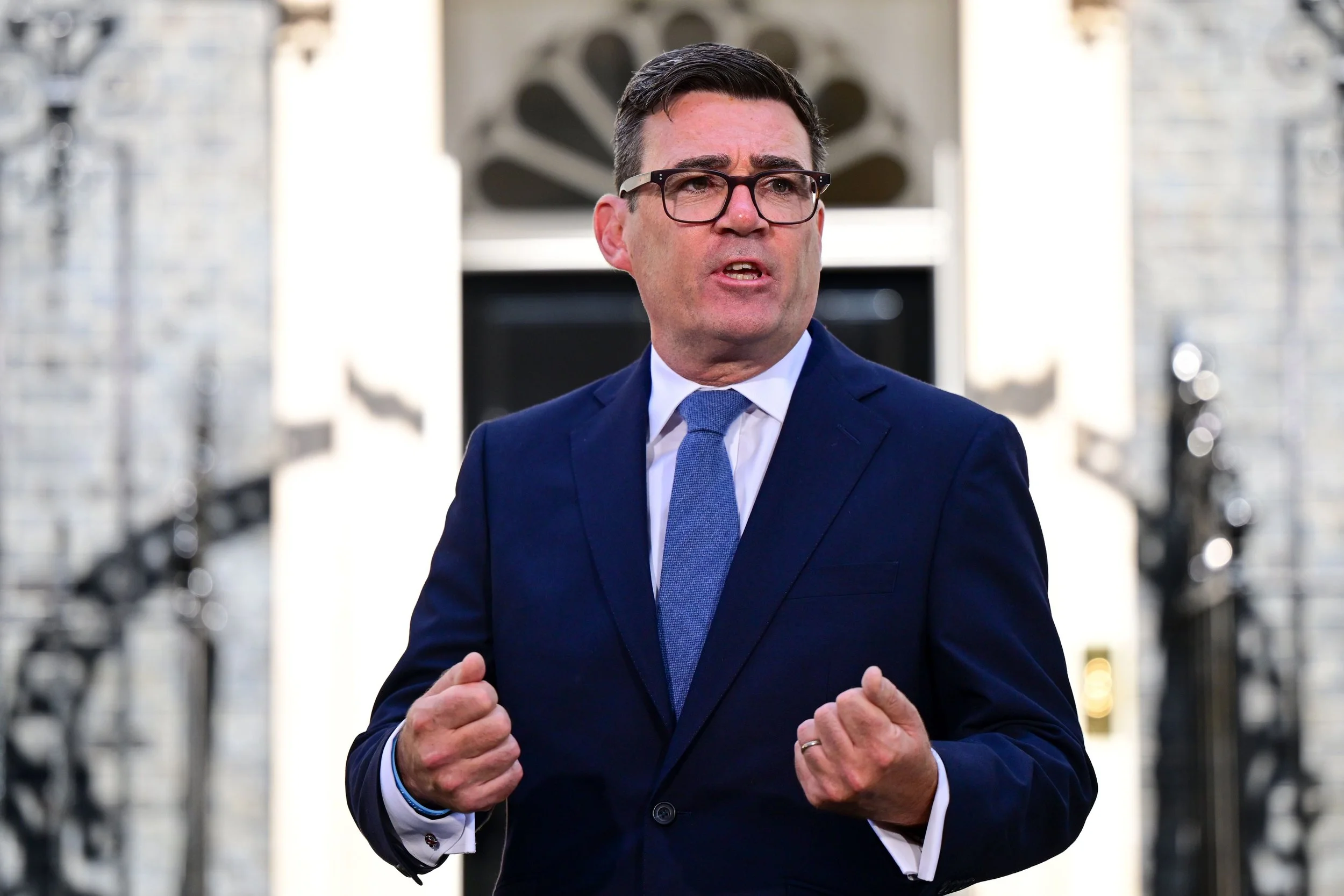
On 20 July, Keir Starmer resigned as Prime Minister, telling the country in his final speech outside Downing Street that his “work is done” and that he was passing “the baton to Andy Burnham.” Constitutionally, this is not unusual. Five of the last even Prime Ministers took office without winning a general election, and party leaders have been installed by their parliamentary colleagues before. It is worth saying plainly, however, that winning 379 nominations following a by-election arranged the month prior, may look engineered to a great many people. Those most likely to share this sentiment loudest may come from those with an existing interest in presenting the British state as a closed shop.
The line “nobody voted for him” does not need to be constitutionally correct in order to be politically effective, and it is likely to be the most repeated sentence in British politics between now and the next election.
On 20 July, Keir Starmer resigned as Prime Minister, telling the country in his final speech outside Downing Street that his “work is done” and that he was passing “the baton to Andy Burnham.” Constitutionally, this is not unusual. Five of the last even Prime Ministers took office without winning a general election, and party leaders have been installed by their parliamentary colleagues before. It is worth saying plainly, however, that winning 379 nominations following a by-election arranged the month prior, may look engineered to a great many people. Those most likely to share this sentiment loudest may come from those with an existing interest in presenting the British state as a closed shop. The line “nobody voted for him” does not need to be constitutionally correct in order to be politically effective, and it is likely to be the most repeated sentence in British politics between now and the next election.
Separately, and without an official explanation, Nigel Farage vacated his Clacton seat on 8 July. Reform UK now has seven MPs, down from eight in May. Speculation suggests that this may be related to the investigation underway, led by the Commissioner for Standards over Farage’s undeclared gifts including one of £5 million.
New Powers to Designate Foreign State Bodies
The National Security (State Threats) Act 2006 received Royal Assent on 8 July, having been introduced on 9 June and taken through every Commons stages in a single day on 17 June. It gives the Home Secretary the power to “designate” any body reasonably believed to be (or previous to have been) involved in foreign power threat activity, where designation is considered necessary to protect the safety or interests of the UK. Expressing support for a designated body, assisting one, or accepting a material benefit from one are now criminal offences carrying up to fourteen years.
On 13 July, the Security Minister laid regulations naming the first three bodies. The Commons approved them on 15 July and the Lords on 16 July, and the designations came into force on 17 July. They cover Iran’s Islamic Revolutionary Guard Corps; the GRU Volunteer Corps, which is said to have absorbed elements of the former Wagner Group; and the Islamic Movement of Companions of the Right, an entity that first surfaced online on 9 March this year, has publicly claimed seven attacks in the UK including the arson of four Hatzola ambulances in Golders Green on 23 March, and which the government assesses to be directed by the IRGC’s Qods Force.
The important thing to note is that this is not the same as proscription, and the difference is crucial. There is no offence of membership or of displaying insignia - Lord Davies of Gower pressed an amendment on the latter point on 30 June, citing Jonathan Hall KC, and lost. Appeals against designation go to the Proscribed Organisations Appeal Commission, the same body that hears proscription appeals. And according to the Home Office’s own factsheet, the practical effect prosecutors are interested in is that a designated body is treated in law rather like a foreign intelligence service, which means they no longer have to prove a foreign power connection in every individual case. The UK therefore now runs to parallel proscription-style regimes with different offences, different defences and different thresholds. No far-right organisation has been designated under the new power.
Palestine Action and the Arrest Figures
On 23 July, the Home Office published its accredited statistics on the operation of police powers under the Terrorism Act 2000 for the year to 31 March 2026. There were 3,061 terrorism-related arrests. In the preceding year there were 238. Of the 3,061, some 2,819 (92%) were linked to showing support for Palestine Action. Of those 2,819, 484 were charged. The remainder were bailed or released under investigation, or released without charge altogether. Just over half of those arrested were women, and one was aged 17 or under. If Palestine Action are taken out of the figures, the total shows only 242 - reflecting similar levels to previous years.
The decision to proscribe Palestine Action increased the UK’s annual terrorism arrest figures roughly thirteenfold, and around six in seven of the people arrested under terrorism powers as a result have not been charged with any offence. The demographic profile bears no resemblance to the population these powers were designed for. And in the same release, the Home Office proposes moving this series from quarterly to six-monthly publication, notwithstanding that most of those who responded to its user survey preferred no change - which would halve the frequency of the data that makes any of the above visible.
Immigration and Asylum Bill
Introduced on 30 June and given its second reading on 13 July, this Bill runs to 53 clauses and does four significant things. Part 1 abolishes the role of the First-tier Tribunal in immigration and asylum appeals, replacing it with an Independent Immigration Appeals Authority in which cases are decided by paid adjudicators rather than judges, with onward appeal to the Upper Tribunal on points of law only. This move from judges to adjudicators employed to decide them is a structural change to the rule of law presented as a fix for a backlog. Part 2 narrows Article 8 "family life" to spouses, partners, parents and children under 18, and directs that no weight be given to family life established while a person was here unlawfully. Part 3 merges refugee status and humanitarian protection into a single "core protection" status. Part 4 creates a power to require people receiving asylum support to make contribution payments. Part 5 rolls back modern slavery protections, including the 30-day recovery period.
Shabana Mahmood's opening speech also announced a government amendment allowing the Home Secretary to disapply section 7 of the Immigration Act 1971 for serious criminals, with the threshold, in her words, "tied to the power to deprive citizenship." The figures she relied on are real and worth quoting: roughly 94,000 people in asylum accommodation at a cost of £3.7bn a year, and more than 150,000 waiting for appeal decisions, with average waits of over a year.
Funding for Jewish Communities and the Missing Hate Crime Strategy
In February 2026, the Home Office announced that £73.4m was to be allocated towards protective security for faith communities. This would include £28.4m for the Jewish Community Protective Security Grant, up to £40m for the Protective Security for Mosques Scheme, and £5m for Places of Worship. On 13 July, however, the Home Office announced a further £251m over three years for policing in Jewish communities, which would account for a further 500 additional officers total an extra 100,000 hours a year and anti-semitism training for every officer in England and Wales. There is no comparable new money for Muslim communities, six weeks after five men were stabbed leaving a mosque in Edinburgh. The guidance page for the mosques scheme has not been substantively updated since 19 December 2025.
The Jewish community has been the target of a terror attack and the national threat level has been raised in response. The funding is an answer to a real emergency and should be described as one. What is harder to explain is why there has been no new hate crime strategy published, consulted on, or announced. Nothing on the subject appears to postdate the Khan Review of March 2024, and the strategy itself expired in 2020. Baroness Gohir asked the government on 24 June when it would be updated, and when the loopholes she identified - the higher threshold for stirring religious hatred than for stirring racial hatred - would be closed. Six weeks on, neither question has been answered. Two attacks, one funding package, and no framework that covers both.
Protests and Disorder Across Scotland
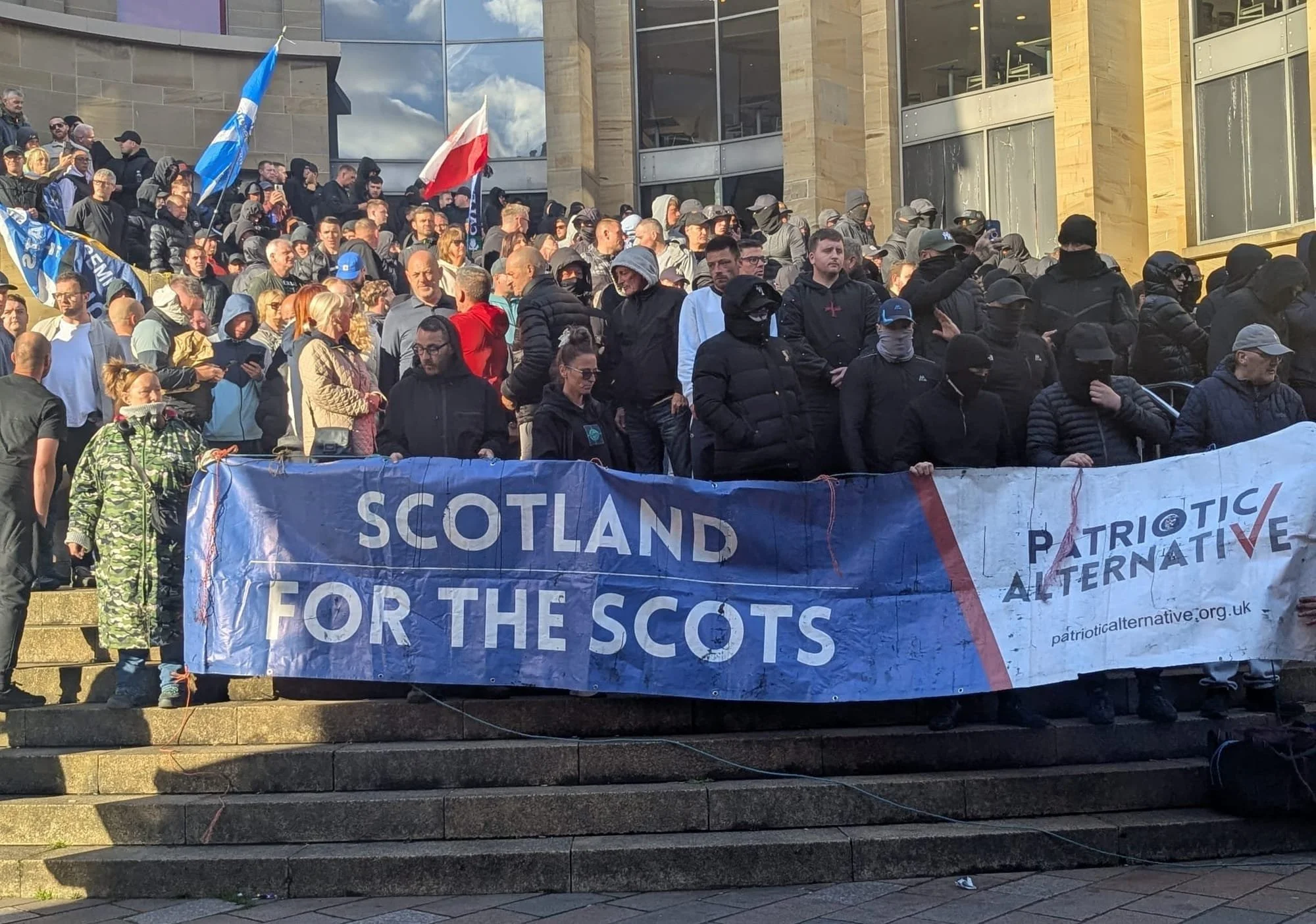
Throughout July, Scotland continued to experience a pattern of disorder linked to protests, with incidents increasingly shifting from public spaces to residential areas. Police Scotland reported multiple arrests in connection with protest-related violence, public disorder and hate-motivated offences, while warning that individuals with criminal histories were exploiting demonstrations to incite unrest. Assistant Chief Constable Alan Waddell emphasised that the police supported the right to protest but would take action against criminal behaviour. On 26 July, the force reported that around 1,700 people had gathered at Glasgow Green the previous day, that a group of roughly 100 had moved through the city centre, and that there had been 15 arrests, weapons recovered and "hate motivated offences" committed. On 29 July, two teenagers aged 17 and 14 were charged following a disturbance in Penicuik, amid protests in Dalkeith, Bonnyrigg and Penicuik.
The month also saw several incidents involving crowds gathering outside private homes, raising concerns about an escalation from public disorder to residential intimidation. This mirrors patterns observed elsewhere in the UK, where individuals and households perceived to be connected to immigration have become targets.
These developments occurred alongside record hate crime figures in Scotland, with racially aggravated offences increasing significantly over the past year. The Crown Office and Procurator Fiscal Service recorded 7,115 hate crime charges in Scotland in 2025-26, a record, and a rise of 17%. Racially aggravated charges were up 17% to 3,990; religiously aggravated charges rose 5.1% to 537. No breakdown of anti-Muslim charges has been published since 2017-18.
What connects Scotland in July to Belfast in June is the shift in target. Last month there was a circulated list of addresses believed to house immigrants. This month there are crowds outside four named properties in Aberdeen, and an innocent household in Castlemilk targeted by mistake. That is an escalation from public disorder to residential intimidation, and it has now happened in two jurisdictions within six weeks.
Prevent and the Southport Enquiry
On 2 July, the government published its response to Phase 1 of the Southport Inquiry and accepted all 67 recommendations, including those directed at Prevent and Counter Terrorism Policing. The same day it published the Home Secretary's response to Lord Anderson's review, Lessons for Prevent, sent as a letter of 30 June to Anderson and to Tim Jacques, who was appointed Independent Prevent Commissioner on 13 April.
Prevent is the machinery underneath every attack covered in this newsletter over the past two months - Southport, Golders Green, Edinburgh, and arguably Belfast. Accepting 67 recommendations is a commitment to rebuild it. The difficulty is that there is currently no way to assess whether any of it is working. The most recent Prevent referral statistics still cover the year to March 2025 and were published in November of that year, which makes the published picture fifteen months out of date.
June 2026
Developments relating to extremism, social cohesion, and political polarisation: from ideologically motivated violence and foreign influence operations, to debates over immigration, citizenship, civil liberties, and the state's response to division and hate.
Belfast Attack and Subsequent Riots
On the evening of 8 June, a man later identified as Hadi Alodid carried out a knife attack on Stephen Ogilvie on the streets of Belfast. During the attack, Ogilvie - a 44-year-old disabled man - was blinded in his left eye and sustained multiple wounds to his face, head, and back. The attack came to an end when members of the public intervened. Although police initially and incorrectly identified the assailant as Somali, it was later revealed that he was in fact a Sudanese asylum seeker who entered the UK in 2023 via the Common Travel Area. Later that year, he was granted refugee status under a fast-track scheme due to Sudan's rapidly deteriorating security and humanitarian situation.
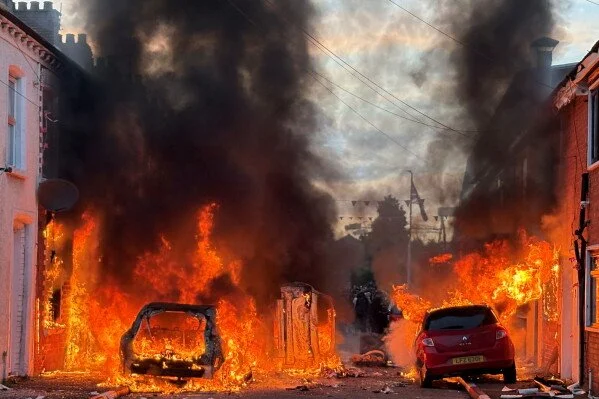
As with other cases in which the perpetrator has been identified as a member of an ethnic minority- particularly where they have been shown to be an asylum seeker - the attack sparked protests that escalated into violence across Belfast and several other areas. Police vehicles were pelted with rocks, masked men took to the streets, and homes believed to house immigrants were set on fire - including a list circulating that contains the addresses of potential targets. Political commentator Owen Jones referred to this as a ‘pogrom.’ Hilary Benn, the Secretary of State for Northern Ireland, described the violence as "racist thuggery," while the government stated that more than two dozen people had lost their homes.
Murder of Henry Nowak
Henry Nowak, an eighteen-year-old university student, was murdered on 3 December 2025 by Vickrum Singh Digwa. Nowak was walking home after an evening out when he encountered Digwa, and the two became involved in a verbal altercation. During the confrontation, Digwa stabbed Nowak five times with a 21 cm dagger that he carried as part of his Sikh faith.
Following the attack, Digwa's brother, Gurpreet, called emergency services. When police arrived, the two falsely reported that Nowak had been racist towards them and had assaulted them. As Nowak lay on the ground telling police officers that he had been stabbed - allegations that Digwa denied - officers arrested and handcuffed him. He subsequently lost consciousness and died shortly afterwards.
On 28 May, Digwa was found guilty of murder by a jury at Southampton Crown Court and was sentenced to life imprisonment with a minimum term of 21 years. Following his sentencing, a "Justice for Henry Nowak" protest took place in Southampton, with Stephen Yaxley-Lennon addressing a crowd outside Southampton Police Station. Other notable attendees included former Britain First leader Paul Golding, UKIP leader Nick Tenconi, and Reclaim Party leader Laurence Fox. While the protest was said to be in Nowak’s name, it focused on scrutinising the police who were accused of ‘two-tier policing,’ and debates around knife laws (as Sikh men are permitted to carry small daggers in accordance with their religious beliefs), and race. Leader of the Reform Party, Nigel Farage, called on the public to respond with ‘pure, cold rage’ - a sentiment that was echoed by US Vice President JD Vance, who blamed Nowak’s death on the ‘mass invasion of immigrants’ and saying that the only legitimate response is ‘righteous anger.’ Such remarks have been criticised by Keir Starmer and other representatives from No. 10 of whipping up division in society.
Both the Belfast and Southampton protests have contributed to growing hostility towards ethnic minorities and, in particular, the Muslim community - issues that the current government has yet to address effectively.
Government’s Ability to Strip Citizenship
On 23rd of June 2026, the Justice and Home Affairs Select Committee on Settlement, Citizenship and Deprivation warned that the proposed powers for granting and withholding citizenship could be misused.
Under current laws, British citizens can lose their nationality if the government believes they are eligible for another citizenship and have engaged in wrongdoing, even if they have never lived in that country or do not identify with it. This became highly controversial in the UK when Shamima Begum, a British citizen, left the country at the age of 16 to join IS fighters in Syria and had her citizenship revoked by the UK government in 2019 after requesting permission to return.
In the Earned Settlement consultation, the government proposed extending the standard qualifying period for settlement to ten years, and to twenty years for refugees on the ‘core protection route’. The Committee notes that a ten-year baseline would be more restrictive than equivalent routes in comparable high-income countries. It further argues that extending qualifying periods risks undermining integration by reducing migrants’ security of status and increasing the likelihood of poverty. A twenty-year route for refugees, combined with requirements to renew documentation every two and a half years, risks compromising both integration and long-term decision-making - two factors that are essential to building strong and resilient societies over the long term.
Palestine Action Trials
In recent years, there has been significant controversy surrounding the government's proscription of Palestine Action as a terrorist organisation due to its involvement in protest activities. This controversy intensified when the High Court initially ruled the proscription unlawful, before subsequently overturning that ruling and upholding the ban on the group. One of the most significant points of contention concerns the sentencing of four Palestine Action activists who were convicted of causing criminal damage at an Elbit Systems factory. Although they were not convicted of terrorism offences, the judge found their actions to have a "terrorist connection", resulting in substantially longer sentences. Alongside the wider debate surrounding the decision to proscribe Palestine Action as a terrorist organisation, concerns have also been raised about the implications this may have for political protest and civil liberties.
During the court proceedings, the defence faced significant restrictions regarding what could be disclosed to the jury. The judge ruled that proceedings should focus solely on the offences at hand - namely criminal damage - with no references made to genocide, the situation in Gaza, or broader arguments concerning the legality of Israel's military actions. While the jury were led to believe that the convictions related only to criminal damage, the judge later ruled that the defendants would face terrorism-related sentencing considerations.
Peter Hain argued that, had modern terrorism legislation existed in the early twentieth century, some suffragettes would likely have been proscribed. He noted that members of the movement engaged in acts including arson, bomb attacks, letter bomb campaigns, and the smashing of windows.
BBC Reveals Russian Involvement in Stoking Division
The BBC has revealed that Russia has been setting up fake far-right and Islamist groups in the UK in an effort to stoke division. According to the investigation, hired operatives have been used to spread extremist propaganda, carry out an arson attack on Keir Starmer's home, and vandalise mosques.
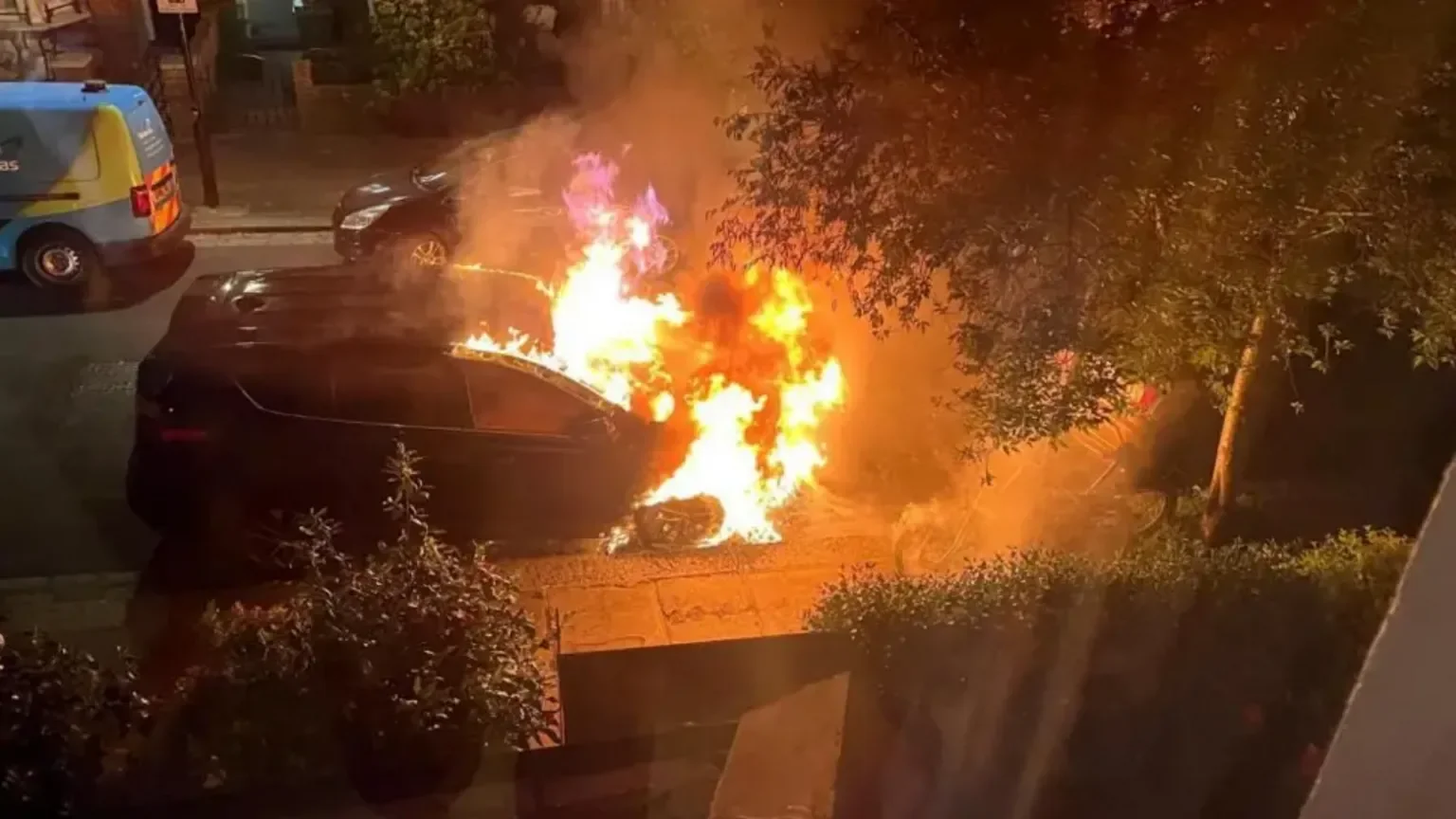
Roman Lavrynovych, a 22-year-old Ukrainian builder, was recruited and directed remotely through Telegram by an anonymous handler known only as "EL" to set fire to Keir Starmer's home. After the attack, the handler reportedly sent him a message stating:
‘Look, you attacked the home of a very high-ranking person in Britain. I’ll send you money, you need to leave the city.’
Unfortunately for Lavrynovych, he was arrested before he could flee.
The BBC investigation claims to have identified the anonymous recruiter as Evgeny Lyukshin, a 23-year-old Russian diplomat and the son of a senior Russian official. The investigation further alleges that Russian citizenship has been offered in exchange for carrying out additional attacks.
It is also claimed that Russian operatives run a broader influence campaign through fake far-right and Muslim social media groups in order to spread disinformation, deepen political and social divisions, and encourage protests and acts of vandalism. Russia's embassy has denied all of the allegations.
Edinburgh Terror Attack
On 19 June, Lewis Hawkes, a 36-year-old Scottish man, carried out a series of stabbing attacks in Edinburgh that appeared to target Muslims, injuring five men near the mosque at Broomhouse as worshippers were leaving Asr prayer. Footage of the arrest, shared on social media, appears to show the suspect shouting that he was "protecting the country from these fucking Muslim bastards raping our young daughters, raping our kids." The perpetrator was charged with attempted murder offences that were said to be "aggravated by reason of having a terrorist connection."
A week after the incident, thousands of people took part in an anti-racist demonstration organised by the Reclaim Our Streets rally. The case highlights ongoing concerns about religiously motivated violence and domestic terrorism. By alleging a terrorist connection, prosecutors are indicating that the attacks may have been intended not only to harm individual victims, but also to intimidate a wider community or advance an ideological cause.
Baroness Gohir addressed these concerns during a parliamentary debate on 24 June, stating:
Power Dynamics in the World Cup
While the world watches with bated breath to see who will be crowned the champions of the 2026 World Cup, significant disparities remain in how national teams are treated - perhaps most notably in the case of Iran. With the tournament being hosted in the United States, strict travel restrictions have been imposed on the Iranian team, who have reportedly been instructed to arrive shortly before their matches and leave promptly afterwards. As a result, players must repeatedly fly in and out of the country, undergoing immigration and security checks each time.
Following matches, much of the attention from journalists and reporters is directed not towards the game itself, but towards broader geopolitical issues such as the Strait of Hormuz and Iranian-US relations. These questions are posed to footballers who would undoubtedly prefer to discuss the sport they are passionate about and the performances they have delivered while representing their country. Comparable questions are not routinely directed at the US team, highlighting an uneven power dynamic that exists despite football's image as a universal and unifying sport.
Human Dimension on Domestic Efforts to Tackle Antisemitism
On 26 June, the UK's Foreign, Commonwealth and Development Office and UK Delegation to the OSCE published a voluntary report highlighting their continued commitment to protecting the Jewish community by treating antisemitism as a form of racism and adopting a zero-tolerance approach. The report identified three key priorities:
Protecting communities through record levels of funding for security at Jewish schools, synagogues, and community sites, alongside enhanced policing and counter-terrorism measures.
Enforcing the law by prosecuting antisemitic crimes, tackling online hate, and restricting extremist actors.
Preventing antisemitism by investing in education, Holocaust remembrance, public awareness campaigns, and broader counter-extremism and social cohesion initiatives designed to address the root causes of hatred.
These measures aim to ensure that Jewish communities are both safe and feel safe, while fostering a society that rejects antisemitism in all its forms. The report also acknowledges the recent attacks in Edinburgh, noting that
These are sentiments we champion wholeheartedly.
May 2026
Rising concerns around extremism, political polarisation, and the impact of inflammatory rhetoric: from the dangers of online radicalisation and ideologically motivated violence, to questions of political accountability in the Reform party, mass protest movements, social division, and the increasingly dehumanising language being used to discuss immigration in political discourse.
Neo-Nazi Convicted of Planning Mass Gun Attack
A senior police officer has warned that an increasing number of young people are being drawn towards violent extremism, after Alfie Coleman - a neo-Nazi who had been planning a mass gun attack - was caught in an undercover MI5 sting operation when he engaged in an online encrypted chat in an attempt to buy weaponry. Coleman, who was working as a Tesco employee in Essex, was found to have compiled a hate-list of potential would-be targets, which included colleagues and customers alike who he branded with racial slurs or as “race traitors,” the mayor of London, and a mosque. Alongside this, while conducting an investigation of Coleman’s bedroom at his family residence, police discovered a rock with a swastika, a variety of rightwing books, a flier for target practice, a black-sun flag which is typically associated with neo-Nazism, and an extensive history on his electronic devices, including communication with Patriotic Alternative - a far-right white supremacist organisation - with whom he expressed interest in “participating in activism.”
The 21-year-old was found guilty on the 30th of April of preparing for terrorist acts, and it came to light that since the age of 14 Coleman had been using the internet to seek out extreme right-wing content, including a neo-Nazi manifesto which he had downloaded. DCS Helen Flanagan warned that younger and younger individuals are becoming radicalised online, with one in five people referred to counter-terrorism agencies being a child. She has expressed that
Alfie was 14 when he first started to look at content online and we had concerns about his behaviour. I think where people are living their lives online they’re getting exposed, and there is an awful lot of horrific material online that is influencing young people. So, clearly, we are keen to intervene at the earliest opportunity to prevent that ideation and radicalisation happening and turning into a real-world threat.
Failed Vetting of Reform Councillors
The May 7th local elections across the UK saw Reform perform exceedingly well, with many Reform councillors taking control of local authority. However, since then, a significant number of these individuals have either been suspended or are subject to investigation, including Glenn Gibbins who was elected to represent Hylton Castle ward in Sunderland City, who has resigned after previous social-media posts came to light, in which he stated that he could not believe the ‘amount of Nigerians in town’ arguing that they should ‘melt them down and fill in the pot holes.’
Stuart Prior, a newly elected Reform councillor for Essex has resigned after racist and Islamophobic posts on Twitter/X have been associated with him. He has claimed in these posts that white people are the “master race” and have “larger brains” as well as saying that “Muslims are dirt” and that “Muslims are awful, globally.” Other Reform members who have resigned in the last year include Robert Bloom of North Northamptonshire, who resigned after being charged with two counts of racially or religiously motivated harassment, and Lynn Dean of Newcastle-Under-Lyme Borough Council who was suspended after allegedly publishing racist posts on X.
‘Radical’ Teen Jailed for Stalking Schoolgirls
Dihan Rahman, a 19-year-old former Army cadet with an extreme hatred of women has been jailed for four-and-a-half years after terrorising two girls, which included posting their personal details online during a stalking campaign. Rahman’s ideology has proven to be mixed, with his electronic devices showing a history of engagement with content that is right-wing (including working as an administrator of an extreme right-wing group on Telegram after pretending to be a white youth), inspired by the Islamic State, or produced by the Incel community pushing the hatred of women. As well as this, the police revealed that he had photographed himself carrying out a Nazi salute, and had collected videos which provided instructions on producing explosives, including a pipe bomb.
Unite the Kingdom 2026
On the 16th of May, the Unite the Kingdom rally (organised by Stephen Yaxley-Lennon, otherwise known as Tommy Robinson) marched through London. The date was selected to coincide with the Nakba Day (15th May) commemoration march which was due to take place on Saturday the 16th, and which spurred a counter anti-fascist demonstration to Yaxley’s own. This led to the closure of large areas of London as two rival demonstrations took to the streets.
Waving Union Jacks and carrying ‘Make England Great Again’ signs, tens of thousands took to the streets as part of the far-right march, calling for an end to migration and the upholding of stronger “Christian values” in the country. Yaxley-Lennon, when addressing his supporters, claimed that they were there ‘in their millions’ to protest in London - a figure that has been widely contested by the Metropolitan Police, who estimated that the rally drew 60,000 people, according to helicopter and CCTV footage. 60,000 protestors in itself is a large turnout, but is over half the number of participants from the year prior and significantly less than the police were expecting and prepared for. This hyperinflation of numbers is an attempt to illustrate the popularity of the movement and attract more support. Similar efforts have also been made through the use of AI-generated photos depicting large crowds during the march. Old protest footage from last year’s Unite the Kingdom rally is also being presented as current imagery.
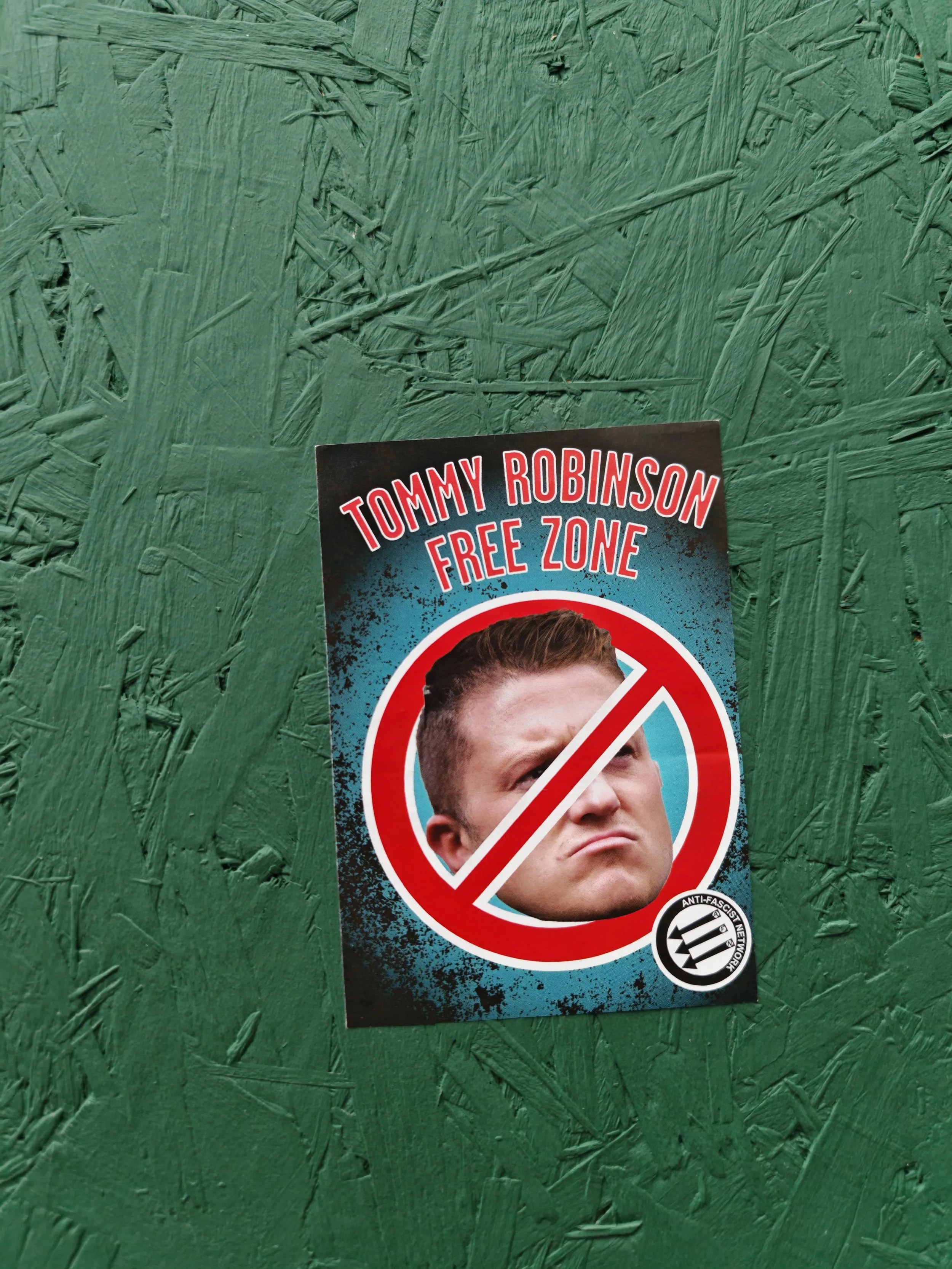
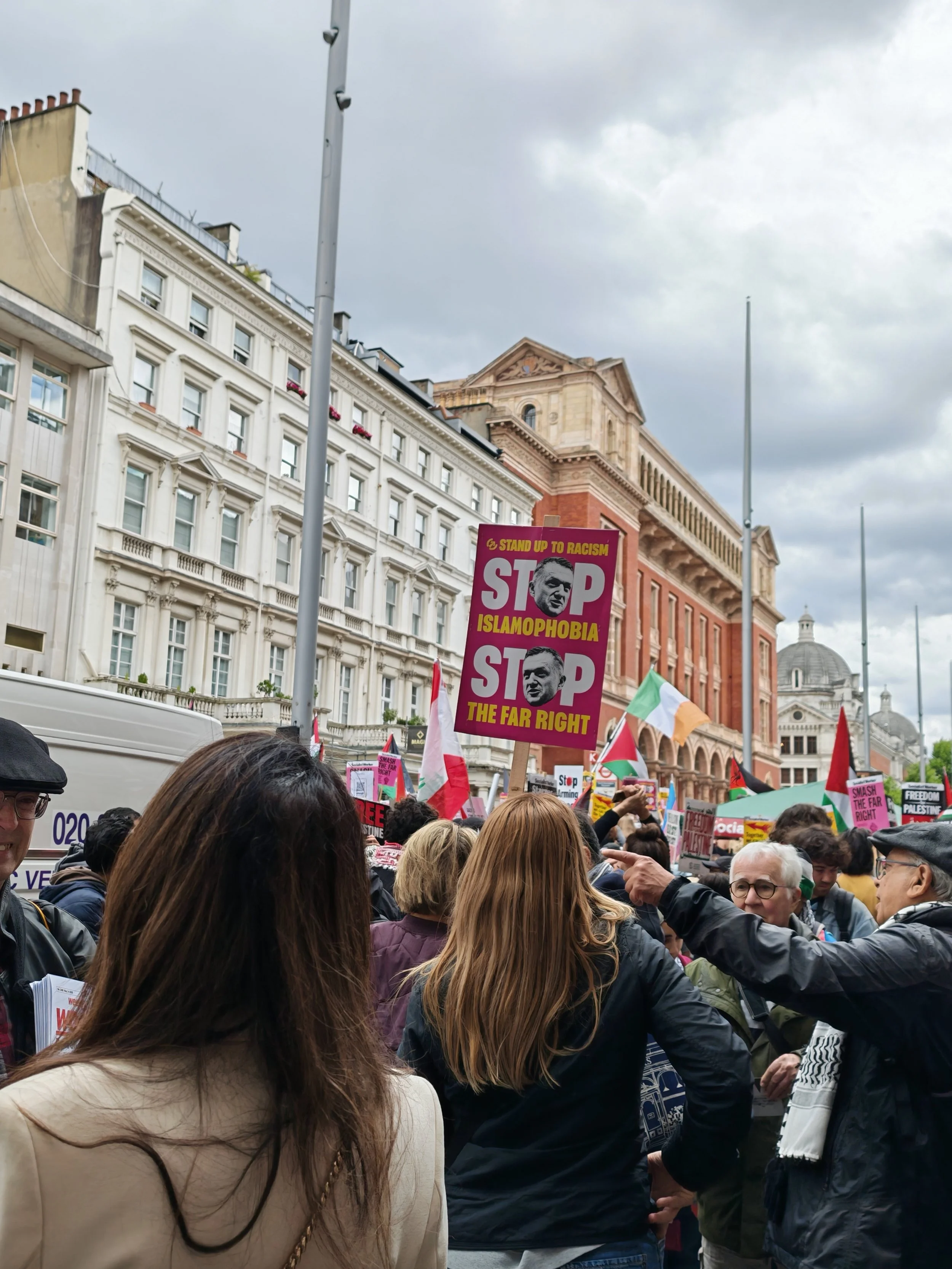
It is estimated that around 20,000 people attended the counter demonstration, marching for a Free Palestine, welcoming refugees, migrants, and asylum seekers, fighting racism, calling for an end to Trump’s war, and standing up to Nigel Farage and the rise of the right-wing.
While Yaxley has argued that the Unite the Kingdom march is not a hate-filled or racist one, eleven speakers who had been invited to speak have had their visas denied by the Home Office, on the grounds that the individuals have been deemed to be a danger to society by inciting hate and/or violence, including Republican candidate Valentina Gomez (read more here).
The Metropolitan police have drawn wide criticism for their lack of action in relation to the rally, which featured three women in burkas on the stage, and a crowd of people chanting “take it off.” The show involved other performances, including a musician who played music with rashers of bacon on his shoulders - a supposed nod to bacon being haram for Muslims.
Addressing the crowd at the march, Robinson stated that men needed to “get fit.” He claimed that “as men, British men. we need to get fight-ready because the fight’s coming to this country.”
At the rally, when a reporter asked Yaxley what he would do if he was prime minister, he answered
I would stop Islam. I’d end foreign funding […], all the migrants would be taken out [of] the hotels and sent back tomorrow by the military. I would reverse… I would have remigration… It’s time for many Muslims to leave this country [if] they’re not going to live similar [lives]. It’s time to go home. You’ve got your homes to go to. This is our home, we’ve got nowhere to go to. We’re not allowing this change any longer. You’ve seen today, people are fed up. People are fed up.
But this is supposedly not about Islam or Muslims.
Ahead of the march, prime minister Kier Starmer shared his sentiments on the approaching event saying that
Tomorrow’s march in London is a reminder of what we’re up against in the battle of our values. The organisers, including convicted thugs and racists, are peddling hatred and division. Plain and simple. Their goal is to convince people that Britain’s problems are caused by those living alongside them. But that is not the Britain that I know. This is a country built on decency, fairness, and respect; a country that is at its best when people from different backgrounds come together in common purpose. This is our country, with the majority who share those values, a majority who may not always be as loud but who must always define who we are.
Multiple arrests were made during and following the Unite the Kingdom rally, when protestors turned violent. The counter-rally remained peaceful.
Update on Southport Riots
The Southport riots of 2024 led to the arrests of 950 individuals. Police record updates show that, in the two years since the riots, 20% of those arrested have been reported to the police for domestic abuse. It had previously been made public that 40% of those arrested had already been the subject of a domestic abuse report prior to the riots. One individual arrested during the riots was 22-year-old Keenan Sanders who, after being released under investigation, carried out a series of attacks against his partner, which included strangulation, threatening her with a knife, and pushing her into oncoming traffic. He is currently serving a ten-year prison sentence.
Dehumanisation of immigrants
Immigrants have been increasingly dehumanised over recent years, with the White House releasing a new statement that takes this one step further. On their website aliens.gov, they released a statement which reads
For 60 years, the U.S. government has kept a closely guarded secret. Aliens have been walking among us, living in our neighborhoods, and interacting with us in our daily lives. They’ve shopped in the same stores, attended the same classes as our children, and lived seemingly normal human existences.
With one exception - they do not belong here.
Millions arrived under the cover of darkness and embedded themselves directly into our society. Countless presidents, congressmen, and senior officials knew exactly what was happening.
Instead of protecting American citizens, they chose to cover it up and even accelerate the invasion.
Until one man finally had the courage to tell the truth.
Bold. Unapologetic. Unafraid.
President Trump was the first to call out the real danger Aliens pose to every American family, every community, and the future of our nation.
The truth is no longer out there. It is right here. Right now.
This is followed by a map of the number of ‘encounters’ as well as an ‘alien arrest map.’ The espousing of this rhetoric causes significant harm to society, building strong communities, and uniting people together and instead does the opposite, which is to sow division and hate - two things that we strongly oppose.
Raise the Colours Founder Charged With Murder
Raise the Colours is a British far-right group which rose to prominence in the autumn of 2025 for its anti-immigrant vigilantism. It was one of the major organisations behind the Operation Raise the Colours campaign - a campaign which saw many members of these organisations take to the streets to raise the Union Jack and English flag, attach them to lampposts, spray paint flags on zebra crossings and round-abouts, as well as on businesses owned by migrants and others areas of public space.
Billy Allison, the founder of the Raise the Colours organisation was charged with murder after Matthew O’Gara - a pub owner near Litchfield - died in hospital on the 26th of May from injuries sustained from being punched by Allison two days prior. Allison has been charged with murder and grievous bodily harm after two people were injured and admitted to hospital after his attack - one of whom has since been released. O’Gara’s death has been described as a heartbreaking loss.
April 2026
Growing tensions around antisemitism, public safety, and political extremism: from targeted attacks on Jewish communities and religiously motivated violence, to civil unrest, contested narratives around crime and identity, and growing concerns over the normalisation of inflammatory rhetoric in political and public discourse.
Two People Stabbed in Apparent Terror Attack in Golders Green
On Wednesday 29 April, two Jewish men 34-year-old Shloime Rand and 76 year-old Moshe Shine - were stabbed in Golders Green, an area of London known for its large Jewish population. Prior to these two stabbings, the assailant attacked a Muslim man in Southwark, though there has been little reporting by the media on this third victim. Police are currently treating the stabbings of the two victims in Golders Green as a terror attack. The 45 year-old suspect was apprehended near the scene whilst looking for more targets and attempting to attack police officers. Authorities report that he has a history of serious violence and mental health issues.
The BBC reports that the suspect had previously been referred to the government’s counter-extremism programme, Prevent. Earlier, the government’s independent reviewer of terrorism legislation, Jonathan Hall KC, stated that attacks on Jews constitute “the biggest national security emergency” in almost a decade.
This is the second attack in a matter of weeks to take place in Golders Green, following an arson attack on ambulances operated by a local Jewish charity. Many members of the community have expressed anger, fear, and frustration that more is not being done to address the rise in antisemitism and violence against Jewish communities. In response, Home Secretary Shabana Mahmood has committed £25 million to increase security around synagogues, schools, and community centres. However, some view this as reactive rather than preventative - akin to placing a plaster over a wound.
A Jewish man speaking to the BBC near the site of the stabbing said:
The UK government is not hospitable for the Jewish community. They say they are, but they do nothing. I don’t feel safe walking down Golders Green High Street, where I’ve lived for years. This country is finished for Jews - people will leave to go to Israel. If my wife said she would move, I would move today. I keep begging her. In the last year, 80% of my friends have moved. Since the 7 October [attack on Israel], this country has gone mental. You only have to look at the pro-Palestinian rallies with over a million people gathering.

Some commentators have linked the rise in antisemitism and the recent stabbing to growing pro-Palestine activism, including large-scale demonstrations. Others have taken to social media to criticise public figures such as Owen Jones and Zack Polanski - both vocal critics of the Israeli government - for expressing solidarity with the Jewish community, accusing them of hypocrisy and, in some cases, assigning them indirect responsibility for such attacks.
Epsom Unrest
In the early hours of 11 April, a young woman was reportedly raped outside Epsom Methodist Church by a group of men. No suspects have been named, which authorities attribute to insufficient evidence and an inconsistency in the facts reported.
This lack of information has fuelled frustration among some members of the local community, with speculation emerging that the absence of named suspects is due to their alleged status as immigrants or asylum seekers rather than evidentiary limitations. The town has since seen two protests, with demonstrators demanding information about the ethnicity of the perpetrators. Following a second protest on Monday 21 April, four individuals were arrested for violent disorder. Surrey Police and Crime Commissioner Lisa Townsend described the behaviour as “mindless” and “shameful.” She also noted that many attendees were not local residents but had travelled from elsewhere to incite hate and cause unrest.
These developments are reminiscent of the protests that spread across the UK in the summer of 2024 following a series of stabbings carried out by Axel Rudakubana at a children’s party, in which three children were killed and ten further people injured, including six children. When police initially declined to disclose details about the perpetrator, online speculation quickly escalated, including claims that authorities were protecting an asylum seeker who had arrived in the UK via a “small boat.” Police later clarified that the perpetrator had been born and raised in the UK, after which public attention shifted to his presumed religion - incorrectly, in many cases, and which led to attacks on mosques, Muslim people, and their properties and possessions.
These incidents point to a concerning shift in public discourse, in which demands for information about a suspect’s ethnicity or religion are increasingly framed as legitimate, and where police face pressure to disclose such details to prevent civil unrest. In parallel, there has been a noticeable increase in calls for deportation when individuals from ethnic or religious minorities commit crimes, rather than a focus on due legal process.
Some commentators have criticised the police response in Epsom, questioning the use of riot control measures against what they describe as a protest composed largely of “mostly white” individuals protesting a serious crime. Among them is Spectator writer Brendan O’Neill.
Police have stated that they will be closing the case due to insufficient evidence, stating that they are “confident there was no offence.” After a “thorough investigation” the police revealed it became clear that the woman in her early 20s had suffered a head injury following a night out, which led to her making a confused report.
Unite the Kingdom Rally and Valentina Gomez
“Unite the Kingdom” is a rally organised by far-right, anti-Islam and anti-immigration activist Stephen Lennon-Yaxley, more commonly known as Tommy Robinson. Yaxley has a well-documented history of organising demonstrations that have, at times, escalated into violence and have been widely criticised for targeting ethnic and religious minorities, particularly Muslim communities.
The first Unite the Kingdom rally, held in summer 2025, was one of the largest right-wing gatherings in recent years and saw incidents of violence and attacks on minority-owned property. Elon Musk participated virtually as a speaker, drawing criticism for engaging in British political discourse and enflaming tensions. Notably, he stated that the British public would need to “fight back or die” in response to migration - remarks widely condemned.

For the upcoming rally, scheduled for May 2026, Republican candidate for Texas Valentina Gomez has been announced as a guest speaker. Gomez has gained notoriety for provocative public actions, including burning the Qur’an, as well as for repeated inflammatory statements about Muslims and ethnic minorities.
Although such speech may fall under protected expression in the United States, it would likely meet the threshold for hate speech under UK law. Gomez’s visa was initially approved by UK authorities, prompting widespread backlash, before being revoked.
In response, Gomez posted a video on social media claiming she had been “banned” from the UK by Home Secretary Shabana Mahmood, whom she referred to as a “dirty Pakistani Muslim,” arguing that the reason she had been refused entry is because she was not travelling “to rape little girls.” She further stated that, having been unable to fly, she would consider travelling by boat and expect to be accommodated in a luxury hotel - a comment widely interpreted as mocking asylum policies.
Attempted Arson Attack at Kenton United Synagogue in Harrow
A series of arson attacks targeting Jewish sites in north-west London has prompted renewed warnings about escalating threats to the community. The latest incident occurred at Kenton United Synagogue in Harrow, where an object containing an accelerant was reportedly thrown through a window overnight, causing minor damage but no injuries. Counter-terrorism police are investigating whether the attacks are connected, with particular focus on a group that has claimed responsibility online for targeting Jewish sites across Europe.
Senior officers have indicated that the group may have links to Iran, specifically through the use of criminal proxies - individuals allegedly paid to carry out acts of violence with little direct ideological affiliation. Authorities have stressed that, if identified, those responsible could face prosecution under national security legislation, carrying severe penalties.
Although physical damage in the most recent attack was limited, the cumulative effect of repeated incidents has contributed to growing concern within the Jewish community, particularly in areas already impacted by recent violence.
Concerns Over Vetting of Reform UK Candidates in Greater Manchester
Several Reform UK candidates and campaigners in Greater Manchester - an area where the party is expected to make electoral gains - have faced allegations of sharing xenophobic, Islamophobic, or antisemitic content online, as well as promoting conspiracy theories relating to COVID-19 and vaccination programmes.
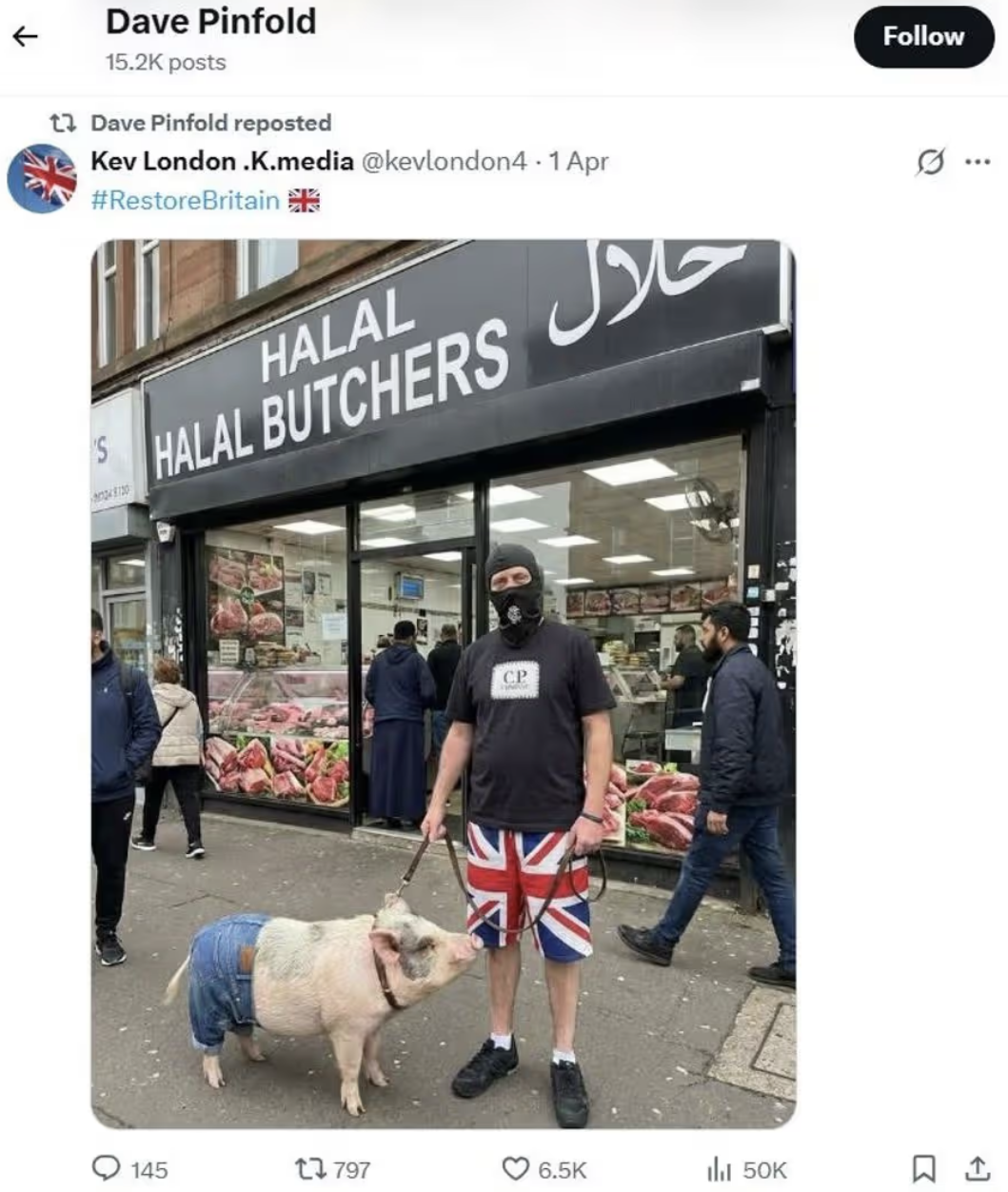
An investigation by the Manchester Evening News highlighted activity by Dave Pinfold, election agent for Reform candidate Peter Marsh (Edgeley). Pinfold is reported to have shared posts describing “Allah as Satan,” calling for the closure of mosques in the UK, and resharing imagery widely regarded as inflammatory.
Responding to the controversy, Pinfold stated:
I did mention to the candidate that some of the social media posts I’ve shared were controversial. I asked if I needed to go through vetting but was told it wasn’t needed because I’m an agent. The thing I’ll say is they’re not my posts; they’re shared from accounts that I follow. […] We have freedom of speech, and in hardline Islamic countries Christians are not allowed to practise their religion—that’s the point I would make.
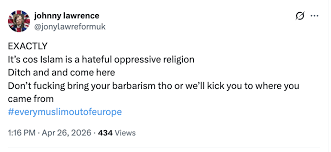
Leo Fruhman, Reform candidate for Mill Hill in Barnet has also recently been exposed for Islamophobic and hateful views shared on Twitter/X under an anonymous account by the name of Johnny Lawrence.
These are not isolated cases. A number of similar incidents involving Reform candidates and affiliates have emerged in recent months, suggesting serious gaps in vetting procedures.
Man Charged in Religiously Motivated Rape Attack
John Ashby, 32, of no fixed address, followed a Sikh woman to her home after she disembarked from a bus in October 2025. At her residence, he raped the victim while subjecting her to Islamophobic abuse, having incorrectly assumed she was Muslim. During a police interview, when shown a photograph of the victim, Ashby reportedly asked why she was not wearing a hijab. The attack has contributed to heightened fear within South Asian communities.
On 24 April, Ashby was sentenced to life imprisonment, with a minimum term of 14 years. The judge described him as a “deeply unpleasant racist and Islamophobe.”
Shaista Gohir, chair of the Muslim Women’s Network, said that this “horrific case exemplifies the ways in which religious hatred is often racialised, with victims being targeted based on perceptions of their appearance, race, ethnicity, or clothing.”
Six Men Jailed in Bolton Grooming Gang Case
Six members of a grooming gang - part of a wider group of ten men - have been jailed for offences committed between 2016 and 2018 in Bolton, involving the rape and abuse of multiple victims aged between 13 and 15.
Sentences varied significantly. Elliot Turner, 36, received a two-year sentence for sexual activity with a minor, while Jack Poulson, 31, was sentenced to 17 years. The ringleader, Ashley Darbyshire, 28, of Westhoughton, pleaded guilty to 19 offences, including multiple counts of rape involving five victims and was sentenced to 15 years’ imprisonment.
March 2026
Shifting dynamics in political discourse, social cohesion, and the role of emerging technologies: from the use of AI-generated content in shaping public opinion, to rising religiously motivated hate crime and debates around freedom of expression.
The use of AI in garnering right-wing support
In recent years, AI-generated content has increasingly been used to shape political discourse by engaging with existing social and cultural tensions. Cases such as Sri Lankan influencer Geeth Sooriyapura’s circulation of Islamophobic material, as well as the emergence of fully AI-generated personas like the musician Danny Bones, illustrate how synthetic media can be used to disseminate political messaging and attract public engagement. In the case of Bones – reportedly linked to the political party Advance UK – AI appears to function as a tool for communicating ideological positions through music and social media messaging. Similar patterns, though less explicitly political, can be observed in figures such as Jessica Foster, an AI-generated influencer and OnlyFans model, whose rapid growth highlights the capacity of such content to build large, responsive audiences. More recent examples include AI-generated videos depicting Muslims in Australia expressing divisive opinions such as that there is too much pork at the butchers, which have circulated widely and, in some instances, been interpreted as authentic and received hostile responses. Taken together, these developments suggest that AI is becoming an increasingly effective medium for influencing perception and participation in online political and social discourse. Read more here.
Attack on Jewish charity-owned ambulances
In the early hours of 23rd March, four ambulances belonging to the Jewish charity Hatzola were set on fire in Golders Green – an area of London with a long-established strong Jewish community. The incident, which caused multiple explosions due to gas cannisters onboard the vehicles, has been treated as an antisemitic hate crime, with the investigation being lead by counter-terrorism police. It occurs within a broader context of rising religiously motivated hate crime across the UK, including incidents in which a children’s nursery and synagogues in Golders Green have had faeces smeared on them, as well as swastikas painted in children’s parks. n the past year, over seven thousand hate crimes have been recorded nationally, with 45% targeting Muslims and 29% targeting Jews, reflecting a broader pattern of hostility affecting multiple religious and ethnic groups, often intensified by divisive political rhetoric.
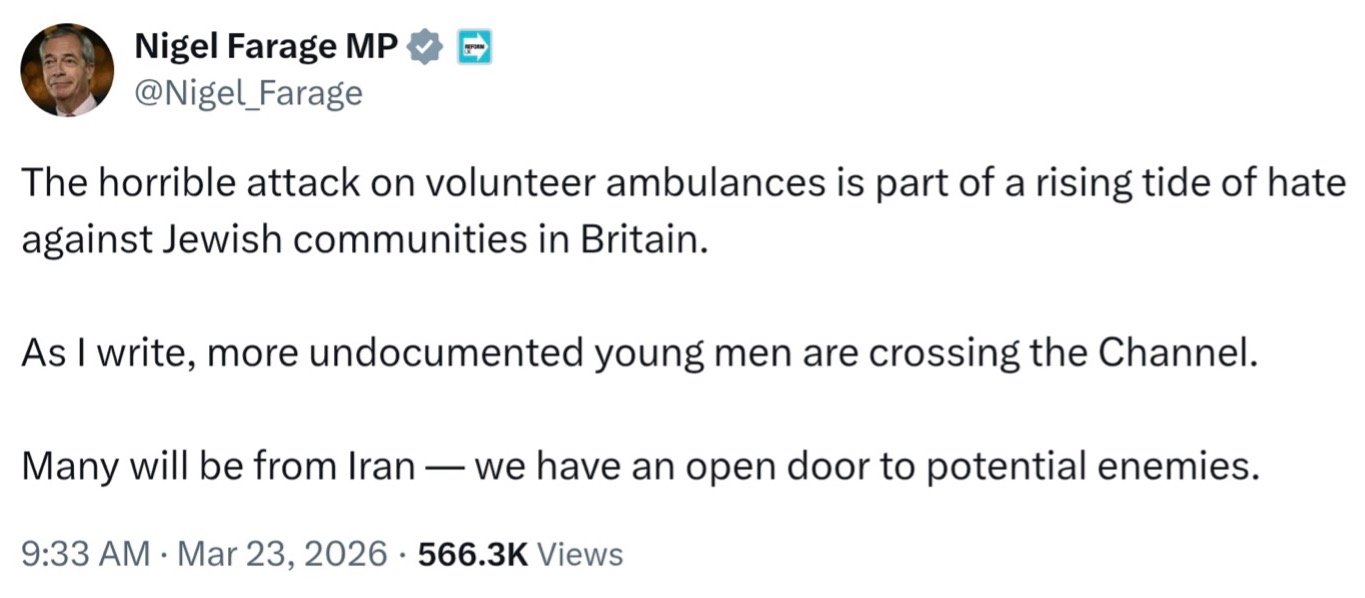
In response to the arson attack on the Hatzola ambulances, Nigel Farage—leader of Reform UK—posted on X suggesting that the incident demonstrated the need for stricter border controls.
Criticism of Muslim prayers held in Trafalgar Square
Trafalgar Square, London, has long been known as a space for all, hosting numerous events throughout the year. It is home to the annual Christmas tree reveal, has repeatedly hosted the Chanukah in the Square event and Diwali celebrations, and more recently saw an iftar organised during Ramadan by the Muslim community. Invitations to the iftar were open to people of all faiths and beliefs, and, at the time of prayer, those who wished to pray did so. Tory MP Nick Timothy described the event as ‘divisive’ and ‘an act of domination’, prompting strong reactions both in support of and against the claim. Objection to one group’s visible practice of religion risks setting a precedent for the restriction of others, raising broader concerns about the erosion of freedoms and liberties that underpin the UK’s constitutional and social framework. This was highlighted by the Jewish News, who published that:
We would be wise to defend that right for others, because what guarantee do we have that if we were taken from them, we would not be next? We would urge those members of the Jewish community who are inclined to support condemnation of such public prayer to consider where such things can lead – it not particularly difficult to see. Attempts in Western countries to circumscribe the Islamic way of life almost always ends up doing the same to Jews. Whether via attempts to ban religious slaughter, religious courts or circumcision – initiatives where a significant percentage of advocates wish to make life more difficult for Muslims will also affect Jews. […]
Uphold religious rights for all – you’ll never know when you’ll be glad that you did.
Similarly, David Taylor from Premier Christianity said:
If we are honest, we have been comfortable with public expressions of faith and belief in that space for years, particularly when they have been our own. We cannot now decide that this is a problem simply because the people gathering are Muslim. We cannot have it both ways. […]
There are a growing group of voices who, intentionally or not, are contributing to a culture of suspicion and exclusion towards Muslims. That is not British and it is not Christian. More worrying still, it is beginning to shape political thinking, with calls for restrictions on public prayer and religious gatherings. Such proposals would not only affect Muslims, they would also have prevented the kind of Christian witness we have seen in Trafalgar Square for years. […]
Christians should be the first to defend the right of Muslims to gather and pray peacefully in Trafalgar Square. Not because we agree, but because we believe in a society shaped by justice, dignity, and freedom.
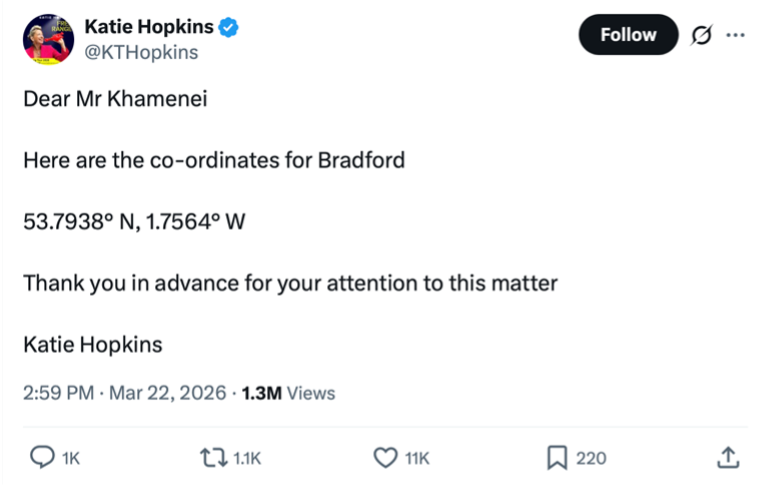
Katie Hopkins provides coordinates for Iran bombing
TV personality and provocateur Katie Hopkins shared a post on X providing coordinates for Khamenei to bomb Bradford. While this was most likely intended as a joke, what is concerning is the number of responses in the comments expressing sentiments that show clear signs of racism.

Both Luton and Tower Hamlets are known as comprising of large South Asian and Muslim communities.
Met Police to resume arrests for Palestine Action support.
The Metropolitan Police has resumed arresting individuals for showing support for Palestine Action, despite a High Court ruling that found the government’s ban on the group to be unlawful. Police maintain that, as the government is appealing the decision, the ban remains in effect and must continue to be enforced until the appeal is heard. This has led to growing concern among activists and civil liberties groups, particularly as over 2,500 arrests have already been made in connection with related protests, including individuals detained for expressions of political support. At the same time, reports from imprisoned activists awaiting trial have raised questions about their treatment, with accounts of prolonged hunger strikes and alleged failures to provide adequate medical care. While the government denies wrongdoing, the situation has prompted broader scrutiny of the use of terrorism legislation in the context of pro-Palestine activism and the implications for freedom of expression.
Restore Britain
Restore Britain, founded by Rupert Lowe – a former member of the Reform party who was ousted for being too extreme – began as a pressure group in June 2025. In recent weeks, Lowe announced that the group would transition into a political party positioned to the right of Reform, a move welcomed by figures such as Katie Hopkins.
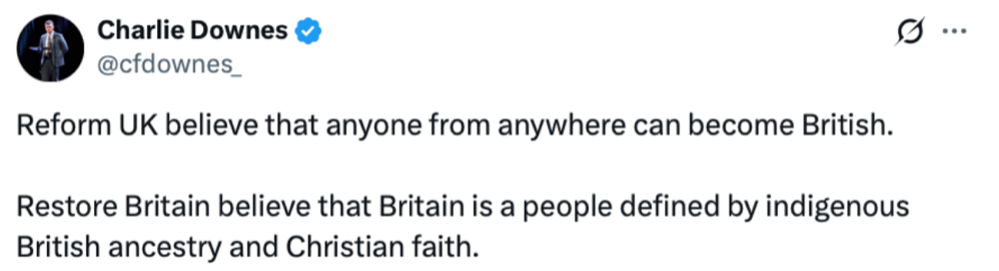
At the launch event, Lowe outlined a policy of mass deportation, claiming that “millions will have to go”—a statement met with clear support from the audience. Tapping into working-class grievances, Restore Britain’s manifesto on its homepage states that
For 30 years, this country has been run into the ground by an establishment that does not care about the interests and concerns of ordinary British people.
Mass immigration, economic collapse, woke ideology, and the relentless creep of radical Islam – everywhere you look, this country is in decline, and has been for a long time.
Time and again, the decent men and women of this country have tried to use the ballot box to make their voices heard, only to have it thrown back in their faces by a political class that has forgotten who they are supposed to be serving. […]
We do not need more of the same – we need a democratic revolution. I am offering you that opportunity, but it is up to you to take it. I hope you will consider joining me in this fight. Together, we will Restore Britain.
While Restore Britain’s following remains relatively small, the more concerning issue is the nature of the support it is attracting. These appear to be individuals on the far right of the political spectrum, many of whom are likely strongly opposed to a multicultural society as it currently exists.