
July 2026
A Change of Prime Minister Without an Election
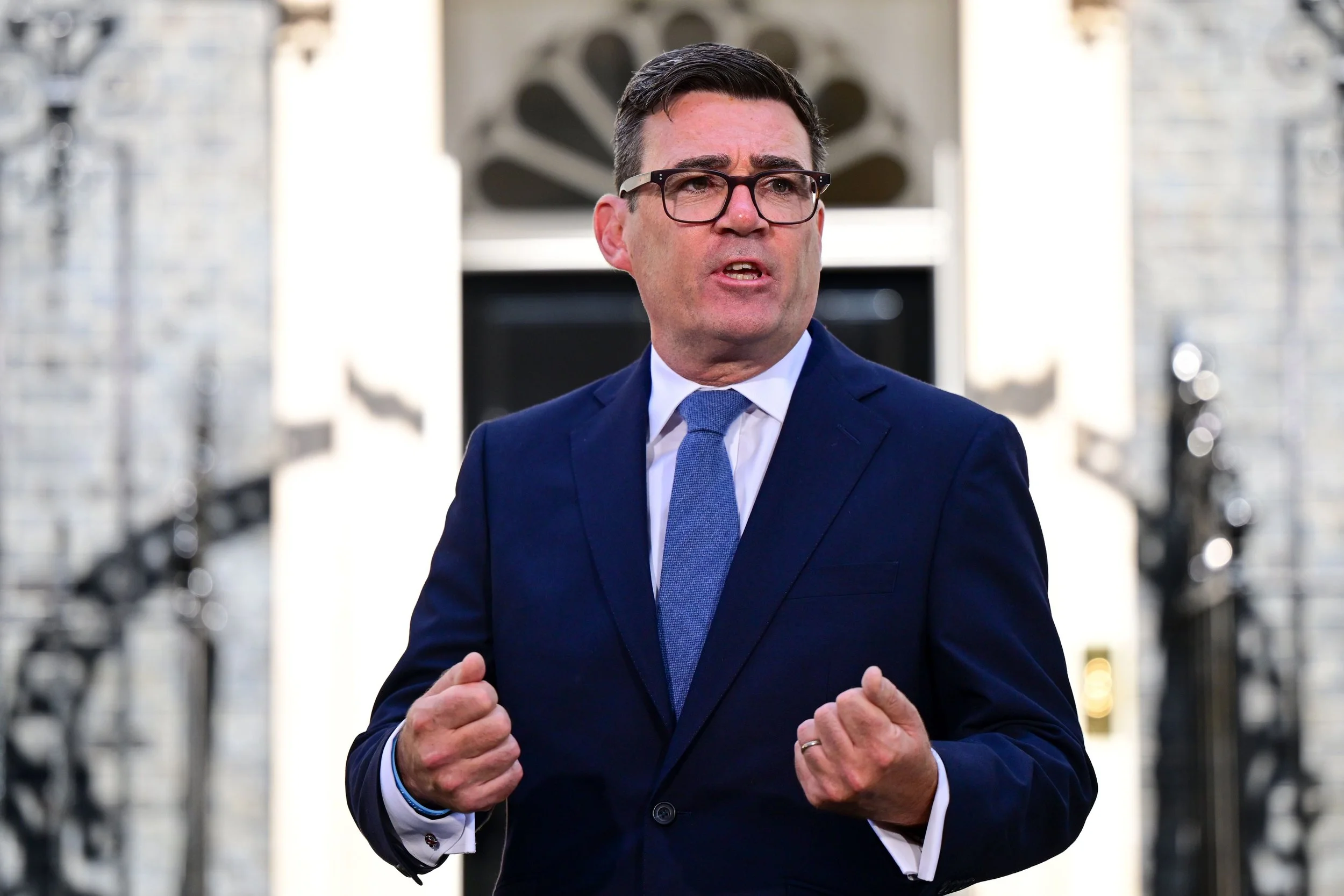
On 20 July, Keir Starmer resigned as Prime Minister, telling the country in his final speech outside Downing Street that his “work is done” and that he was passing “the baton to Andy Burnham.” Constitutionally, this is not unusual. Five of the last even Prime Ministers took office without winning a general election, and party leaders have been installed by their parliamentary colleagues before. It is worth saying plainly, however, that winning 379 nominations following a by-election arranged the month prior, may look engineered to a great many people. Those most likely to share this sentiment loudest may come from those with an existing interest in presenting the British state as a closed shop.
The line “nobody voted for him” does not need to be constitutionally correct in order to be politically effective, and it is likely to be the most repeated sentence in British politics between now and the next election.
On 20 July, Keir Starmer resigned as Prime Minister, telling the country in his final speech outside Downing Street that his “work is done” and that he was passing “the baton to Andy Burnham.” Constitutionally, this is not unusual. Five of the last even Prime Ministers took office without winning a general election, and party leaders have been installed by their parliamentary colleagues before. It is worth saying plainly, however, that winning 379 nominations following a by-election arranged the month prior, may look engineered to a great many people. Those most likely to share this sentiment loudest may come from those with an existing interest in presenting the British state as a closed shop. The line “nobody voted for him” does not need to be constitutionally correct in order to be politically effective, and it is likely to be the most repeated sentence in British politics between now and the next election.
Separately, and without an official explanation, Nigel Farage vacated his Clacton seat on 8 July. Reform UK now has seven MPs, down from eight in May. Speculation suggests that this may be related to the investigation underway, led by the Commissioner for Standards over Farage’s undeclared gifts including one of £5 million.
New Powers to Designate Foreign State Bodies
The National Security (State Threats) Act 2006 received Royal Assent on 8 July, having been introduced on 9 June and taken through every Commons stages in a single day on 17 June. It gives the Home Secretary the power to “designate” any body reasonably believed to be (or previous to have been) involved in foreign power threat activity, where designation is considered necessary to protect the safety or interests of the UK. Expressing support for a designated body, assisting one, or accepting a material benefit from one are now criminal offences carrying up to fourteen years.
On 13 July, the Security Minister laid regulations naming the first three bodies. The Commons approved them on 15 July and the Lords on 16 July, and the designations came into force on 17 July. They cover Iran’s Islamic Revolutionary Guard Corps; the GRU Volunteer Corps, which is said to have absorbed elements of the former Wagner Group; and the Islamic Movement of Companions of the Right, an entity that first surfaced online on 9 March this year, has publicly claimed seven attacks in the UK including the arson of four Hatzola ambulances in Golders Green on 23 March, and which the government assesses to be directed by the IRGC’s Qods Force.
The important thing to note is that this is not the same as proscription, and the difference is crucial. There is no offence of membership or of displaying insignia - Lord Davies of Gower pressed an amendment on the latter point on 30 June, citing Jonathan Hall KC, and lost. Appeals against designation go to the Proscribed Organisations Appeal Commission, the same body that hears proscription appeals. And according to the Home Office’s own factsheet, the practical effect prosecutors are interested in is that a designated body is treated in law rather like a foreign intelligence service, which means they no longer have to prove a foreign power connection in every individual case. The UK therefore now runs to parallel proscription-style regimes with different offences, different defences and different thresholds. No far-right organisation has been designated under the new power.
Palestine Action and the Arrest Figures
On 23 July, the Home Office published its accredited statistics on the operation of police powers under the Terrorism Act 2000 for the year to 31 March 2026. There were 3,061 terrorism-related arrests. In the preceding year there were 238. Of the 3,061, some 2,819 (92%) were linked to showing support for Palestine Action. Of those 2,819, 484 were charged. The remainder were bailed or released under investigation, or released without charge altogether. Just over half of those arrested were women, and one was aged 17 or under. If Palestine Action are taken out of the figures, the total shows only 242 - reflecting similar levels to previous years.
The decision to proscribe Palestine Action increased the UK’s annual terrorism arrest figures roughly thirteenfold, and around six in seven of the people arrested under terrorism powers as a result have not been charged with any offence. The demographic profile bears no resemblance to the population these powers were designed for. And in the same release, the Home Office proposes moving this series from quarterly to six-monthly publication, notwithstanding that most of those who responded to its user survey preferred no change - which would halve the frequency of the data that makes any of the above visible.
Immigration and Asylum Bill
Introduced on 30 June and given its second reading on 13 July, this Bill runs to 53 clauses and does four significant things. Part 1 abolishes the role of the First-tier Tribunal in immigration and asylum appeals, replacing it with an Independent Immigration Appeals Authority in which cases are decided by paid adjudicators rather than judges, with onward appeal to the Upper Tribunal on points of law only. This move from judges to adjudicators employed to decide them is a structural change to the rule of law presented as a fix for a backlog. Part 2 narrows Article 8 "family life" to spouses, partners, parents and children under 18, and directs that no weight be given to family life established while a person was here unlawfully. Part 3 merges refugee status and humanitarian protection into a single "core protection" status. Part 4 creates a power to require people receiving asylum support to make contribution payments. Part 5 rolls back modern slavery protections, including the 30-day recovery period.
Shabana Mahmood's opening speech also announced a government amendment allowing the Home Secretary to disapply section 7 of the Immigration Act 1971 for serious criminals, with the threshold, in her words, "tied to the power to deprive citizenship." The figures she relied on are real and worth quoting: roughly 94,000 people in asylum accommodation at a cost of £3.7bn a year, and more than 150,000 waiting for appeal decisions, with average waits of over a year.
Funding for Jewish Communities and the Missing Hate Crime Strategy
In February 2026, the Home Office announced that £73.4m was to be allocated towards protective security for faith communities. This would include £28.4m for the Jewish Community Protective Security Grant, up to £40m for the Protective Security for Mosques Scheme, and £5m for Places of Worship. On 13 July, however, the Home Office announced a further £251m over three years for policing in Jewish communities, which would account for a further 500 additional officers total an extra 100,000 hours a year and anti-semitism training for every officer in England and Wales. There is no comparable new money for Muslim communities, six weeks after five men were stabbed leaving a mosque in Edinburgh. The guidance page for the mosques scheme has not been substantively updated since 19 December 2025.
The Jewish community has been the target of a terror attack and the national threat level has been raised in response. The funding is an answer to a real emergency and should be described as one. What is harder to explain is why there has been no new hate crime strategy published, consulted on, or announced. Nothing on the subject appears to postdate the Khan Review of March 2024, and the strategy itself expired in 2020. Baroness Gohir asked the government on 24 June when it would be updated, and when the loopholes she identified - the higher threshold for stirring religious hatred than for stirring racial hatred - would be closed. Six weeks on, neither question has been answered. Two attacks, one funding package, and no framework that covers both.
Protests and Disorder Across Scotland
Throughout July, Scotland continued to experience a pattern of disorder linked to protests, with incidents increasingly shifting from public spaces to residential areas. Police Scotland reported multiple arrests in connection with protest-related violence, public disorder and hate-motivated offences, while warning that individuals with criminal histories were exploiting demonstrations to incite unrest. Assistant Chief Constable Alan Waddell emphasised that the police supported the right to protest but would take action against criminal behaviour. On 26 July, the force reported that around 1,700 people had gathered at Glasgow Green the previous day, that a group of roughly 100 had moved through the city centre, and that there had been 15 arrests, weapons recovered and "hate motivated offences" committed. On 29 July, two teenagers aged 17 and 14 were charged following a disturbance in Penicuik, amid protests in Dalkeith, Bonnyrigg and Penicuik.
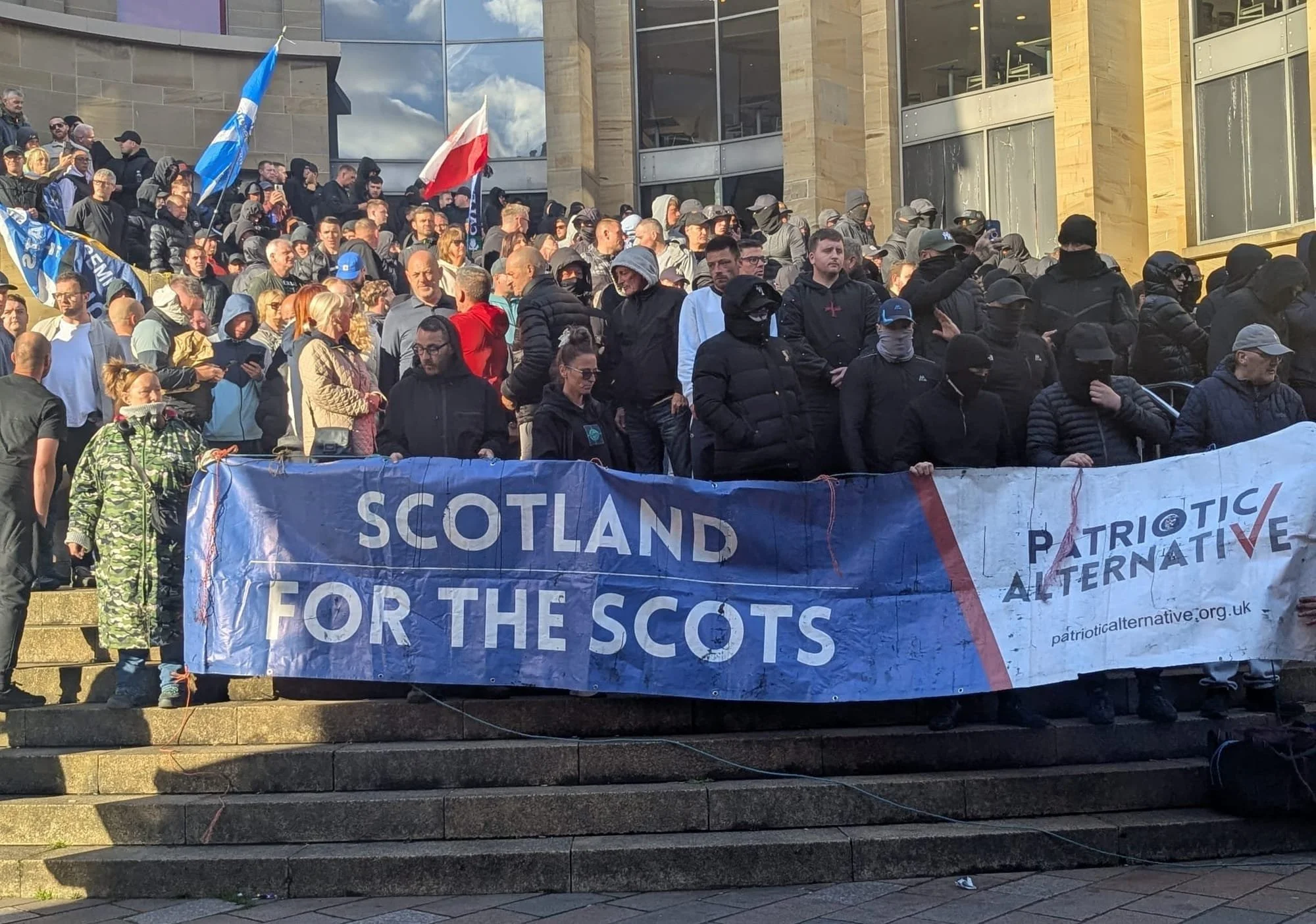
The month also saw several incidents involving crowds gathering outside private homes, raising concerns about an escalation from public disorder to residential intimidation. This mirrors patterns observed elsewhere in the UK, where individuals and households perceived to be connected to immigration have become targets.
These developments occurred alongside record hate crime figures in Scotland, with racially aggravated offences increasing significantly over the past year. The Crown Office and Procurator Fiscal Service recorded 7,115 hate crime charges in Scotland in 2025-26, a record, and a rise of 17%. Racially aggravated charges were up 17% to 3,990; religiously aggravated charges rose 5.1% to 537. No breakdown of anti-Muslim charges has been published since 2017-18.
What connects Scotland in July to Belfast in June is the shift in target. Last month there was a circulated list of addresses believed to house immigrants. This month there are crowds outside four named properties in Aberdeen, and an innocent household in Castlemilk targeted by mistake. That is an escalation from public disorder to residential intimidation, and it has now happened in two jurisdictions within six weeks.
Prevent and the Southport Enquiry
On 2 July, the government published its response to Phase 1 of the Southport Inquiry and accepted all 67 recommendations, including those directed at Prevent and Counter Terrorism Policing. The same day it published the Home Secretary's response to Lord Anderson's review, Lessons for Prevent, sent as a letter of 30 June to Anderson and to Tim Jacques, who was appointed Independent Prevent Commissioner on 13 April.
Prevent is the machinery underneath every attack covered in this newsletter over the past two months - Southport, Golders Green, Edinburgh, and arguably Belfast. Accepting 67 recommendations is a commitment to rebuild it. The difficulty is that there is currently no way to assess whether any of it is working. The most recent Prevent referral statistics still cover the year to March 2025 and were published in November of that year, which makes the published picture fifteen months out of date.